


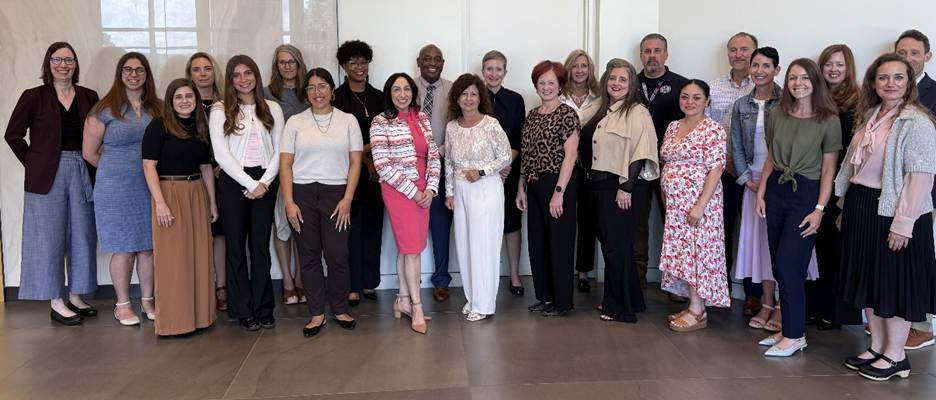
The Family Violence Criminal Homicide Prevention Taskforce Members and Staff at their final meeting of 2026.
Agency and Statewide Updates
The meeting kicked off with members sharing updates from their work in family violence programs, state agencies, research settings, and prevention to ground everyone in what is happening currently across the state. It was wonderful to hear from each member about their current work and in some cases, what is on the horizon.
Members shared wonderful things their agencies were taking on from advancing BIPP to new partnerships at family violence agencies to advance survivor access to support and healing. A moment of inspiration came from one of our taskforce members who shared that at each meeting they carry the work home to make changes and another who was able to point to the landmark creation of the taskforce to inspire better data collection.
Key Insights About BIPPs
Because members feel strongly that stopping violence necessitates prevention and intervention efforts with people using violence, BIPPs were a major focus of this meeting discussion. BIPPs came up time and again in each meeting so members were eager to hear more from experts like TCFV’s very own Maria Jose Angelelli, David Almager at Denton County Friends of the Family, Maisha Colter at AVDA and Jennifer Santana with Texas Department of Criminal Justice-Community Justice Assistance Division (TDCJ-CJAD). Throughout the day, they learned about the underpinning philosophy of BIPPs, the challenges they face, and the current state of BIPP programs in Texas, including their effectiveness.
The discussion emphasized that BIPPs focus on accountability rather than anger management and recognize domestic violence as a pattern of coercive control and abusive choices, rather than a loss of control resulting from anger.
Members learned that BIPPs can face a variety of challenges, including limited availability in rural communities, transportation and distance barriers, a lack of multilingual programs, mental health and substance use concerns, insufficient funding, and pressure to offer shorter or less expensive programs. There is also continued confusion among courts and referral sources about the distinction between BIPP and anger management, as well as limited services for certain populations, including youth. Another significant challenge is that many individuals enter BIPP only after significant harm has occurred or after becoming involved with the criminal justice system. A recurring theme throughout the meeting was that BIPP should be viewed as an early prevention and intervention strategy rather than solely as a response after serious violence has already occurred.
Members also heard about research demonstrating the effectiveness of BIPPs in reducing reoffending, with multiple Texas studies showing positive outcomes. A 2025 TCFV/TDCJ-funded study found substantial differences in re-arrest rates between individuals who completed BIPP and those who did not, with much lower recidivism rates among those who completed the program. This information was of great interest to the members, as they learned that BIPPs are an evidence-based way to reduce family violence in communities.
A Vision for the Future
As the meetings of this taskforce come to a close, the members weren’t quite ready to close out their work as they feel there is still much to be done. By December 2026 the task force will produce a report that will serve both as a record of its work and as an educational resource—and notably will outline the group’s legislative and other recommendations. The taskforce’s policy workgroup members worked diligently to think through and refine the legislative recommendations, which were discussed with the broader taskforce as well. The taskforce’s work will continue through their recommendations but the taskforce also spent significant time in this final meeting discussing a possible extension of the taskforce and potential priorities if their work is extended.
There was broad interest in moving toward deeper case analysis, prevention, early intervention, and the development of practical tools. Many members felt a key priority would be to conduct detailed case reviews of family violence homicides to better understand how to prevent them, learning from day-to-day assessments. Members also emphasized the importance of prevention and early intervention, including addressing the impact of children’s exposure to domestic violence, dating violence among young people, healthy relationship education, identifying precursors to violence, and reaching individuals before violence escalates.
The task force also identified several lethality factors that warrant further examination, including technology-facilitated abuse, previous acts of family violence, pregnancy, and the impact of domestic violence on children. Improving coordination across systems was another major priority.
Members proposed developing practical resources and tools to support these efforts. Potential products included firearms transfer protocols, dispatch and 911 protocols, strangulation and stalking resources for advocates, and scenario-based safety-planning tools.
The taskforce meetings concluded with the same sense of passion and commitment that the group brought to its work in January—a shared determination to prevent and reduce family violence homicides. So much learning, discussion, and policy development took place over the last eight months, and still members spoke about this time as the beginning of their work together, not the end. They want to track the policy recommendations as those measures move through the Legislature, and they also hope to continue this work together in the future. They made thoughtful suggestions about how this work can continue forward in an even deeper way, as outlined above. Several members shared though that significant changes are already taking place through their involvement in the taskforce. They noted how much these discussions transformed their own work and the broader work of their agencies and organizations, as they shared and implemented what they learned through the taskforce.
The overarching feeling in the room as the taskforce wrapped up such impactful work, for the time being, was: keep this momentum going. There was celebration of how far they’ve come and acknowledgement that there is still a long road ahead to keep Texans safe from lethal family violence. This was an incredible group to work alongside, support, and witness. Through their learning and contributions, the relationships they developed, and the upcoming report with plans for a way forward, they are making a difference in the lives of survivors in Texas for many years to come.
2025 HONORING TEXAS VICTIMS REPORT
Honoring Texas Victims is a report compiled by TCFV which presents an annual fatality review of victims killed by intimate partners. It pays tribute to Texans who lost their lives by memorializing their story and offers an analysis of data drawn from these tragic loses. In addition to the report, we publish victims’ narratives and fact summaries for women, men, and same-sex partner

Stay Connected
Follow along with the taskforce’s progress through our monthly updates, and feel free to reach out to TCFV’s policy team at policy@tcfv.org with any questions or thoughts—we’d love to hear from you!
Jen Mudge, TCFV’s Legislative Public Policy Manager and the voice behind this blog, can be found clocking in long hours at the Capitol during legislative session (basically her seasonal residence), advocating for policies that support survivors’ safety, rights, and voices. She is also honored to co-lead TCFV’s survivor involvement work. Her advocacy began over 25 years ago as a volunteer and has been shaped by the experiences of survivors, family, and friends—fueling her ongoing commitment to systems change in Texas. Outside of work she has entered her birdwatching era and finds joy and wonder in the natural world, from a lichen hugging a rock to a craggy, majestic live oak.
Related Posts
Homicide in Slow Motion
“Stalking is homicide in slow motion. The most common use of the criminal justice system prior to attempted or completed intimate
Family Violence Criminal Homicide Taskforce Formed
“The creation of this task force is about accountability and learning directly from families and survivors. I’m hopeful its work will
Strangulation is an Enforcement Mechanism of Coercive Control
“Strangulation is an enforcement mechanism of coercive control.” All violence is not equal—it matters what the function of the